
Make Room For Mushrooms
The Ergothioneine Edge: Why Your Body’s Forgotten Defence System Is The Key to a Healthier Brain

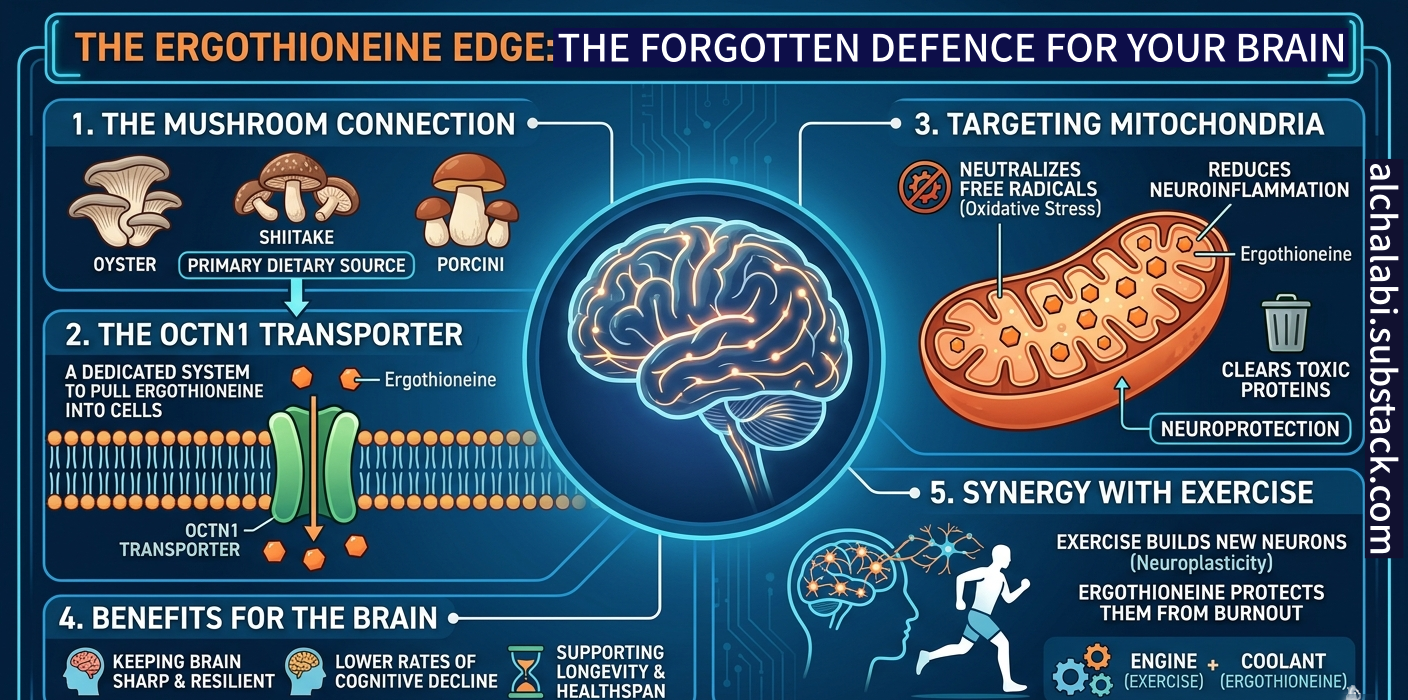
When talking to people about healthy ageing, there is a lot of confusion about what actually moves the needle. We all know about the likes of creatine and omega-3, but there is a specific compound most people have never heard of that might be one of the most important pieces of the longevity puzzle.
If you care about keeping your brain sharp and your body resilient as you get older, please read on. I hope this will convince you that there is a secret weapon hiding in your grocery store’s produce aisle.
There is a naturally occurring amino acid called ergothioneine that might make the difference between a long life and a long, healthy life.
All things health and longevity is a reader-supported publication. To receive new posts and support my work, consider becoming a free or paid subscriber.
If you want to protect your brain and fight ageing at a cellular level - and given what I’ve written before about creatine, I hope you do - you need to know about the “longevity vitamin” that most doctors aren’t telling you about. Not a fad. Not a drug. A fundamental piece of human biology we are just beginning to understand.
Let me explain why this compound is so special and why you need to start including it in your diet.
The Mushroom Mystery
For decades, scientists have known about ergothioneine. It was discovered in 1909 in a fungus, but for the longest time, everyone ignored it. They assumed it was just another nice-to-have antioxidant, but nothing special.
Here’s where they were wrong.
In 2005, researchers discovered that the human body has a specific, dedicated transporter for ergothioneine . Think about that for a second. Your body doesn’t waste energy building specialized machinery to import a nutrient unless that nutrient is essential for survival. We have transporters for glucose, for amino acids and, as it turns out, for ergothioneine. The transporter is called OCTN1, and it actively pulls ergothioneine from your food into your cells, specifically targeting areas under the most stress: the liver, the bone marrow and, most importantly, the brain.
Nature doesn’t build a subway system to a ghost town. If your body is working this hard to get ergothioneine, it means it needs it to function.
The Brain Protection You Didn’t Know You Needed
So, what is it actually doing in your brain?
This is where the latest science gets exciting. Ergothioneine is a master antioxidant, but it operates differently to the vitamins you buy at the pharmacy because ergothioneine gets inside the cellular machinery.
Specifically, it accumulates in mitochondria, the tiny batteries inside your cells that generate energy. As we age, these batteries rust from the inside out, a process called oxidative stress. This rust is a primary driver of neurodegeneration, which is the physical loss of brain cells that leads to memory loss and cognitive decline.
Recent studies published in major journals (see links below) show that ergothioneine is a neuroprotective powerhouse. It doesn’t just stop the rust; it also reduces neuroinflammation (brain swelling) and supports the garbage disposal systems (currently believed to be via perivascular drainage) that clear out toxic proteins, namely amyloid-beta (Aβ) plaques . In short, it helps keep your brain clean and energized.
The Data Is Hard to Ignore
If the biochemistry isn’t enough for you, look at the human data. We aren’t just guessing about this stuff anymore.
Researchers have found that low blood levels of ergothioneine are a red flag for trouble ahead. One comprehensive review published in recent months noted that observational data consistently link low ergothioneine levels to cognitive impairment, frailty and even cardiovascular disease.
Specifically, studies on ageing populations show that individuals with higher levels of ergothioneine have lower rates of dementia and Parkinson’s disease. In animal models, supplementing with ergothioneine has been linked to a significant extension of healthspan.
The Exercise Connection (Bonus Points)
I wrote recently about how I love creatine for the brain. Interestingly, ergothioneine might work even better when you pair it with physical activity.
A recent short review in a major biochemistry journal proposed that ergothioneine and exercise are a “match made in (cognitive) heaven”. Why? Because exercise builds new blood vessels and neurons (neuroplasticity), while ergothioneine protects those new, fragile cells from burning out. One builds the engine, the other provides the coolant.
Why Isn’t Everyone Using This?
Three main reasons:
Firstly, it’s new. The discovery of the specific transporter is only 20 years old. Science moves slowly and dietary guidelines move even slower.
Secondly, food sources. You can’t get massive doses from a standard steak and potato diet. The richest source by far is mushrooms, specifically oyster, shiitake and porcini. Unless you are eating pounds of gourmet mushrooms daily, your levels might be suboptimal.
Thirdly, awareness. Most general practitioners are focused on treating disease, not optimizing cellular longevity. They won’t check your ergothioneine levels because, frankly, most don’t know to look.
What You Should Do
If you want to take advantage of this science, you don’t necessarily need expensive IV drips. The simplest approach is to eat more mushrooms. Add a handful to your omelette or scrambled eggs in the morning and slice a few in your salad, or just stir fry them and serve them as a side dish to your main course. They are delicious.
If you are looking for a more targeted approach, consider supplementation. Ergothioneine is stable, safe and has been approved as a food ingredient in Europe and the US . Because it isn’t a drug, quality can vary but the pure compound is widely available.
The Bottom Line
Ergothioneine isn’t a magic pill. It won’t undo decades of poor sleep and high stress. But the evidence is overwhelming that this “forgotten” nutrient plays a non-negotiable role in brain health and longevity.
We have a specific gene that reaches out and grabs this compound to protect our most vital organ. Don’t starve your body of the tools it needs to defend itself.
Eat your mushrooms and start giving your brain the edge it deserves.
Want to dig a little deeper? Here are a few recent scientific publications about ergothioneine:
Ergothioneine for cognitive health, longevity and healthy ageing: where are we now?
Ergothioneine and exercise: A match made in (cognitive) heaven?